
Introduction
The mobile app ecosystem has transformed dramatically. With over 92 billion app downloads expected from the iOS App Store alone by the end of 2025, the stakes have never been higher for app developers and marketers seeking visibility. App store optimization has evolved from basic keyword placement into a sophisticated, data-driven discipline that integrates artificial intelligence, user behavior analytics, and cross-platform strategies.
This comprehensive guide explores the future of ASO, the critical role of AI in app recommendations, and the emerging concept of intelligent app discovery that will define mobile app success in 2025 and beyond. Google Play’s promotional content allows developers to submit content for events, offers, and major updates to enhance app visibility, providing additional opportunities for strategic app marketing.
Key Takeaways
- AI-powered app recommendations are revolutionizing discovery: Machine learning algorithms now personalize the app store experience, making traditional keyword-only strategies insufficient for sustained growth and requiring app marketers to focus on user engagement signals.
- Intelligent app discovery extends beyond search: Platform algorithms now prioritize engagement metrics, retention rates, and user satisfaction over raw download velocity, fundamentally changing how app store optimization strategy must be structured for competitive advantage.
- Future of ASO demands retention-first positioning: The 2025 landscape emphasizes long-term user relationships through retention optimization and engagement metrics, complementing traditional app store optimization tactics with behavioral signals that directly influence app store rankings.
- AI app recommendations blur the line between organic and paid: Custom product pages, targeted campaigns, and AI-assisted tools are creating new opportunities for app discovery beyond conventional app store search, enabling hyper-personalized marketing approaches that improve conversion rates.
- Mobile app discovery requires platform-specific approaches: Each app store operates distinct algorithms with unique ranking factors—Apple’s metadata-driven signals differ fundamentally from Google Play’s machine learning model, demanding customized app store optimization strategies for maximum visibility.
Current State of App Store Optimization: Why ASO Remains Essential
The role of app store optimization in app marketing has become non-negotiable. With approximately 5,500 new apps launching daily and 2 million new apps released annually, standing out in crowded app stores requires a deliberate, data-driven approach to app store optimization. Improving the app’s visibility through ASO directly leads to more organic app downloads, as users are more likely to discover and install apps that appear prominently in search results.
App store optimization fundamentally addresses two critical objectives: improving organic visibility in search results and increasing conversion rates from store visitors to active app downloads. Optimizing the app store page—including visuals, descriptions, and keywords—is a key factor in converting app store visitors into downloads. The importance of ASO cannot be overstated, as organic acquisition remains significantly more cost-effective than paid user acquisition, with global average acquisition costs ranging from $2.24 to $2.85 per install across all categories. The Apple App Store allows a 100-character keywords field, while Google Play does not have a hidden keywords field and instead indexes the visible description text heavily.
The Business Case for App Store Optimization
App store optimization works as the foundational pillar of app marketing strategy because it directly influences how potential users discover your application. Unlike traditional paid advertising, effective app store optimization generates sustainable, long-term organic traffic that reduces dependency on costly paid user acquisition campaigns. Key strategies for ASO include optimizing the app’s title and app description to reflect the app’s core functionality and integrate primary keywords naturally; using compelling visuals; improving user ratings and reviews; and continuously monitoring and updating the listing.
Consider the current market dynamics: the Apple App Store generated $138 billion in revenue in 2025, while Google Play Store contributed $80 billion—yet iOS users spend nearly double per app compared to Android users. This disparity underscores why app store optimization strategy must be approached differently across platforms. The app description plays a strategic role on both iOS and Android, as a well-written, keyword-rich, and natural-sounding app description can improve search rankings and increase user downloads. Integrating primary keywords naturally into the app’s title is essential for improving search visibility and rankings. The future of mobile app discovery depends on understanding these nuanced differences and tailoring app store optimization tactics accordingly. The Apple App Store allows for a subtitle of up to 30 characters, which can be used to include additional keywords, while Google Play does not have a separate subtitle field. The Apple App Store has a 30-character limit for titles, while Google Play also has a 30-character limit but emphasizes the importance of including keywords in the description instead.
Current ASO trends emphasize several core practices that successful app marketers implement:
Metadata Optimization and Keyword Strategy: The foundation of app store optimization remains strong keyword research combined with strategic placement in app title, subtitle, and description fields. However, app store algorithms have evolved to understand semantic meaning rather than exact matches, requiring more sophisticated keyword strategy that emphasizes relevance over density. A/B testing is a powerful method for optimizing app store presence by trying out variations of assets and measuring performance. Both app stores allow for A/B testing, but the Apple App Store has introduced Product Page Optimization to test different app icons, screenshots, and preview videos, while Google Play allows testing of various elements like icons and descriptions. The Apple App Store does not index the long description for keywords, while Google Play does, albeit with less weight than the short description.
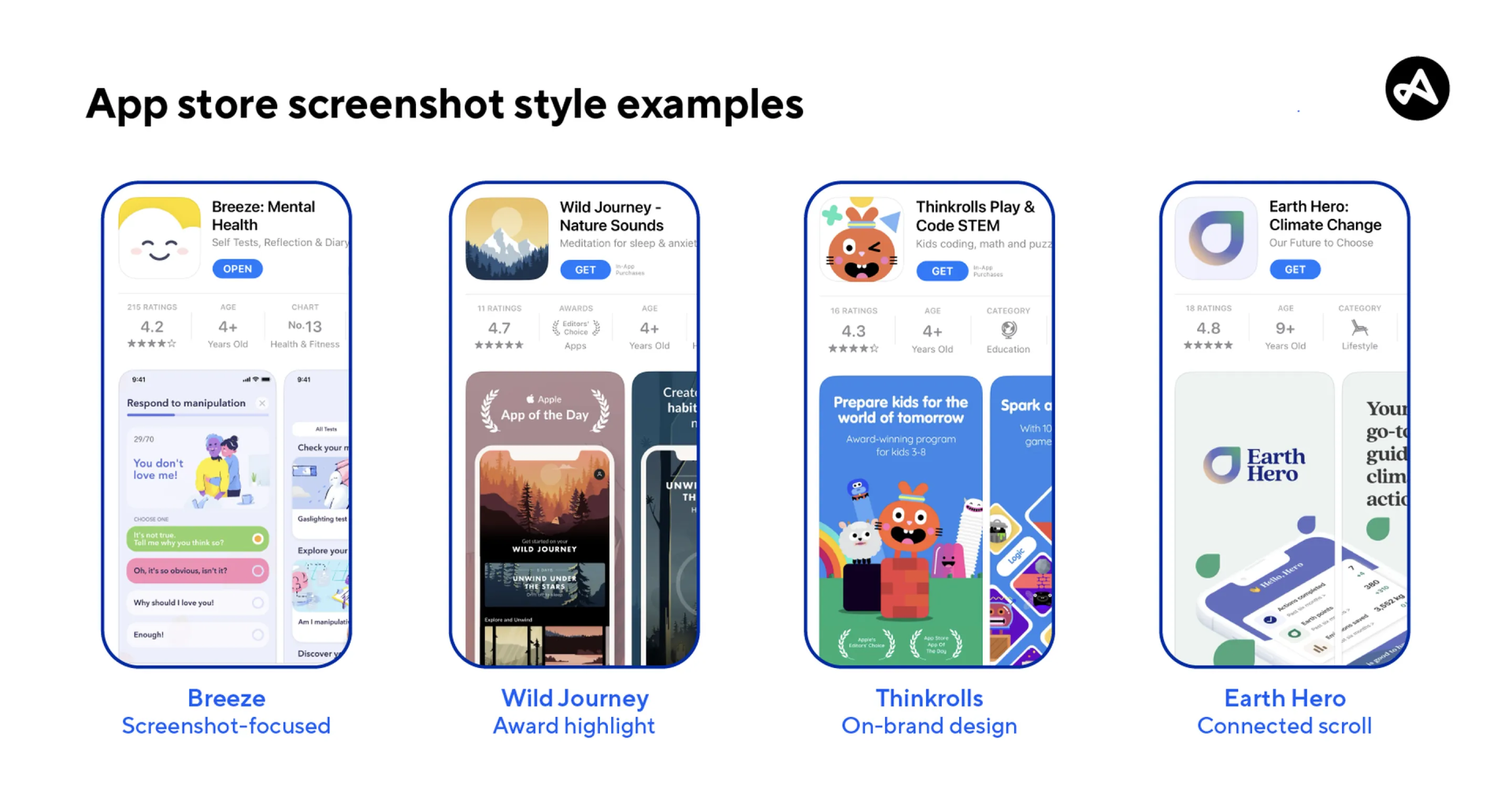
Visual Asset Mastery: Screenshots, app icons, and app preview videos have become increasingly critical ranking factors. Apps investing in high-quality visual content see significant conversion rate improvements, with some reporting 25% increases in store listing conversion rates through optimized creative assets. Apple introduced Product Page Optimization (PPO) to allow A/B testing of app icons, screenshots, and preview videos on the App Store, enabling developers to refine their visual strategies effectively. The first screenshot is the most crucial and should showcase either the main screen or a key feature with a punchy headline. Screenshots should tell a story across the gallery, showcasing the app’s main value propositions to engage users effectively. The App Store places a strong emphasis on visuals, prominently showcasing assets such as screenshots and preview videos in the search results, while Google Play shows more listings in the search results and displays engagement metrics.
Engagement and Retention Signals: App store algorithms now prioritize metrics that indicate genuine user satisfaction. Download velocity, while still important, no longer dominates ranking calculations. Instead, user retention rates, engagement metrics, and low uninstall rates signal app quality and user satisfaction to ranking algorithms. Ignoring user ratings and reviews can significantly hurt an app’s visibility and credibility. On the Apple App Store, keywords in the app title carry the strongest weight for ASO indexation, while on Google Play, the title is also crucial but the short description and long description are indexed for keywords. Apple’s App Store does not allow keyword repetition in the title, subtitle, and keyword field, while Google Play emphasizes keyword density and allows repetition in the title and descriptions.
App Store Algorithms and Ranking Factors
App store algorithms are the invisible engines that determine which apps rise to the top of search results and which remain hidden. Both the Apple App Store and Google Play Store deploy proprietary algorithms that weigh a complex mix of factors to rank apps for every user search. For app developers and marketers, understanding these ranking factors is essential for effective app store optimization (ASO) and sustained app growth.
The primary ranking factors include keyword relevancy, the quality and completeness of app metadata, user engagement metrics, ratings, reviews, and download velocity. App store algorithms prioritize apps that closely match user searches with relevant keywords and well-structured metadata. However, the landscape has evolved: modern app store algorithms now place significant weight on user engagement—such as session duration, retention rates, and in-app activity—alongside traditional signals like download numbers.
On the Apple App Store, the algorithm heavily considers the app’s title, subtitle, and keyword field, while Google Play’s algorithm indexes the app’s title, short description, and long description for keyword relevance. Both platforms reward apps that maintain high user ratings and positive reviews, as these are strong indicators of user satisfaction and app quality. Download velocity—how quickly an app accumulates installs—remains a factor, but it is now balanced by engagement and retention metrics to ensure that only high-quality, relevant apps remain visible in search results.
Effective app store optimization requires a deep understanding of these algorithms and a commitment to ongoing store optimization. By continuously refining app metadata, monitoring user engagement, and responding to user feedback, developers can improve their app’s ranking and visibility in both the Apple App Store and Google Play Store.
ASO Differences Between Apple App Store and Google Play Store
While both the Apple App Store and Google Play Store are leading app stores, their distinct approaches to app discovery and presentation require tailored optimization strategies. These differences directly impact how users interact with search results and how developers should approach app store optimization.
The Apple App Store places a strong emphasis on visual assets in search results. When users browse the App Store, they are greeted with prominent app icons, screenshots, and preview videos, making visual storytelling a critical component of ASO. The app’s title and subtitle are also highly visible, but the search results page typically displays fewer apps at once, allowing each listing to stand out with rich visuals.
In contrast, the Google Play Store’s search results are more text-centric, displaying more app listings per page and highlighting app titles, ratings, and engagement metrics such as download counts and app vitals. This layout encourages users to compare multiple apps quickly, making keyword-rich app titles and strong engagement signals especially important for visibility. Google Play also indexes the app’s description for keywords, providing additional opportunities for optimization.
Understanding these platform-specific nuances is vital for maximizing app visibility. On the Apple App Store, investing in high-quality screenshots and preview videos can significantly boost conversion rates, while on Google Play, optimizing app titles and leveraging engagement metrics are key to standing out in crowded search results. Developers who adapt their ASO strategies to the unique features of each app store are best positioned to capture user attention and drive more downloads.
Keyword Research and Optimization
Keyword research is the cornerstone of successful app store optimization. It involves identifying the most relevant keywords that potential users are likely to enter when searching for apps like yours. Effective keyword research starts with analyzing competitors, uncovering market gaps, and selecting keywords that offer a balance of high search volume and manageable competition.
To maximize your app’s visibility in the app store, it’s essential to conduct thorough keyword research using specialized ASO tools such as AppTweak, Sensor Tower, or App Radar. These tools provide insights into keyword trends, search volume, and competitor rankings, enabling you to refine your keyword strategy for optimal results.
Once you’ve identified your target keywords, keyword optimization involves strategically placing them in your app’s metadata—specifically the app title, subtitle, and description. On the Apple App Store, the title and keyword field are critical, while on Google Play, the title, short description, and long description all contribute to keyword indexation. The goal is to ensure your app appears in relevant search results without keyword stuffing, which can harm readability and user experience.
Regularly updating your keyword list based on performance data and emerging trends ensures your app remains visible to potential users. By prioritizing relevant keywords and optimizing your app’s metadata, you can significantly improve your app’s ranking in search results and attract more organic downloads.
A/B Testing and Experimentation
A/B testing is a vital component of modern app store optimization, empowering developers to make data-driven decisions that enhance app performance and drive more downloads. By systematically experimenting with different versions of app assets—such as app icons, screenshots, and descriptions—developers can identify which elements resonate most with users and optimize their app store listing accordingly.
Both the Google Play Console and Apple’s Product Page Optimization offer robust A/B testing capabilities. On Google Play, Store Listing Experiments allow you to test variations of your app’s icon, screenshots, and descriptions with a subset of users, providing clear data on which version performs best. Similarly, Apple’s Product Page Optimization enables developers to test different creative assets and messaging on the App Store, helping to refine the app’s visual and textual presentation.
This iterative approach to store optimization is essential for staying competitive in the app store. By continuously testing and refining your app’s assets, you can increase conversion rates, improve user engagement, and ultimately drive more downloads. A/B testing also helps mitigate the risks of major changes by validating ideas with real user data before rolling them out to your entire audience.
Synergy of ASO with Paid User Acquisition
App store optimization (ASO) and paid user acquisition (UA) are most effective when deployed together as part of a holistic app marketing strategy. While ASO focuses on maximizing organic visibility and conversion through optimized app store listings, paid user acquisition—such as Apple Search Ads or Google App Campaigns—drives targeted traffic to your app.
The synergy between ASO and paid UA is powerful: a well-optimized app store listing increases the conversion rate of paid traffic, reducing user acquisition costs and improving return on investment. Conversely, paid campaigns can boost your app’s download velocity and engagement metrics, which in turn feed positive signals into app store algorithms and enhance organic rankings.
Coordinating ASO and paid UA efforts enables developers to accelerate app growth, capture more market share, and maintain a competitive edge in the app store. For example, launching a paid campaign alongside a major app update or creative asset refresh can amplify results, while ongoing ASO ensures that both organic and paid users encounter a compelling, high-converting app store listing.
By integrating store optimization with paid user acquisition, app marketers can drive both organic and paid downloads, maximize app growth, and achieve sustainable success in the increasingly competitive app marketplace.
The Future of ASO: Looking Towards 2025 and Beyond
The trajectory of app store optimization is shifting fundamentally. What worked in 2023 increasingly underperforms in 2025, as app store algorithms mature and incorporate more sophisticated ranking signals. Understanding this evolution is essential for developing effective app store optimization strategies that maintain competitive advantage.
How AI Is Reshaping App Store Optimization
Artificial intelligence has fundamentally transformed how apps are discovered, recommended, and ranked within mobile app stores. Google Play’s machine learning algorithms, for instance, now employ sophisticated deep learning models including candidate generators, rerankers, and multi-objective optimization systems that simultaneously evaluate hundreds of factors in real-time.
These AI-powered systems create what industry experts call “intelligent app discovery”—a paradigm where app recommendations become hyper-personalized based on individual user behavior, app usage patterns, and contextual factors. This represents a seismic shift from the keyword-based discovery model that dominated app store optimization just years ago.
The evolution of app store optimization reflects broader trends in machine learning and AI. Modern recommendation systems process vast amounts of user data to identify patterns and preferences that traditional app store optimization methods simply cannot capture. Netflix’s recommendation system, often cited as an industry benchmark, drives 80% of platform engagement through AI-powered suggestions—a metric that app stores are rapidly approaching through comparable technology implementations.
Predictions for App Store Optimization in 2025
As app store optimization strategies evolve, several critical trends are emerging that will shape success in 2025 and beyond:
Hyper-Personalization Through AI: App store algorithms now deliver genuinely personalized product pages and recommendations to different user segments. Custom Product Pages on iOS and Custom Store Listings on Google Play enable developers to present different versions of their app store listing to different audiences, dramatically improving conversion rates by aligning with user intent at the moment of discovery.
Engagement-Weighted Ranking Algorithms: The shift toward valuing engagement metrics over raw install numbers represents a fundamental change in how app store optimization affects visibility. Apps with strong retention metrics, low uninstall rates, and high session duration rankings now receive algorithmic boosts even with lower absolute download volumes.
Cross-Device and Cross-Platform Continuity: Future app store optimization must account for seamless user experiences across devices. Users discovering an app on their phone might complete the purchase or sign-up on tablet or web, requiring app store optimization strategies that integrate with broader app marketing and retention ecosystems.
Voice Search and Conversational Discovery: As voice assistants become more prevalent, app store optimization strategies must increasingly account for natural language queries and conversational search patterns rather than traditional keyword phrases.
Intelligent App Discovery: The Next Frontier of Mobile App Marketing
Intelligent app discovery represents a fundamental reconceptualization of how users find and evaluate applications. Rather than users actively searching for specific keywords, intelligent discovery systems proactively recommend relevant apps based on user behavior, preferences, and contextual signals.
Understanding Intelligent App Discovery
Intelligent app discovery systems combine multiple data sources to create recommendation algorithms that understand user intent at a deeper level than simple keyword matching. These systems analyze:
- User’s app installation history and usage patterns
- Similar users’ preferences and behaviors
- Contextual signals like time of day, device type, and location
- Explicit user preferences and search queries
- Implicit signals from browsing behavior and engagement
Google Play’s recommendation system exemplifies this approach, employing transformer models that process sequential user behavior data to predict app relevance with unprecedented accuracy. This system analyzes over one million apps in real-time, ranking them by predicted relevance for each individual user.
The implications for app store optimization strategy are profound. Developers can no longer rely solely on traditional keyword optimization for app store listings. Instead, they must ensure their apps perform well on multiple dimensions: engagement, retention, ratings, reviews, and user satisfaction metrics that feed into intelligent recommendation algorithms.
The Role of AI in Intelligent App Discovery
Artificial intelligence serves as the engine powering intelligent app discovery. Machine learning models learn from billions of user interactions to identify patterns that humans cannot detect manually. These models continuously evolve, becoming more sophisticated and accurate over time.
Key AI techniques powering intelligent discovery include:
Deep Learning and Neural Networks: Transformer models and other deep learning architectures process complex, high-dimensional user behavior data to identify subtle patterns in app preferences. These models capture long-range dependencies in user behavior sequences that simpler statistical methods miss.
Collaborative Filtering: These algorithms identify users with similar preferences and recommend apps that similar users have installed and engaged with successfully. The approach leverages the collective intelligence of millions of users to guide recommendations.
Content-Based Recommendation: AI systems analyze app metadata, descriptions, categories, and features to identify similarities between apps. Users who install one app are recommended similar apps based on these feature overlaps.
Multi-Armed Bandit Algorithms: Recommendation systems continuously test different ranking orders to optimize for platform objectives (engagement, retention, monetization) while exploring new apps that might be relevant to users.
Importance Weighting and Bias Correction: Sophisticated algorithms correct for algorithmic biases that emerge when certain apps receive disproportionate visibility. An app installed by 10% of users shown the app might seem equally popular as an app installed by 10% of users in a much smaller audience—importance weighting corrects for these distortions.
The practical effect is that intelligent app discovery dramatically changes app discovery dynamics. Apps that would never rank high for specific keywords can gain significant visibility if they satisfy user demand and maintain strong engagement and retention metrics.
AI App Recommendations: Transforming User Experience and Business Outcomes
AI-powered app recommendations represent one of the most consequential developments in app store marketing. These systems don’t just improve user experience—they fundamentally reshape how app developers must approach app store optimization and user acquisition strategy.
How AI Enhances App Recommendations
Modern AI recommendation systems operate on principles fundamentally different from traditional app store search. Rather than matching keywords to app metadata, AI systems predict user preferences based on observed behavior and similar user patterns.
The benefits are substantial and measurable:
Improved Conversion Rates: Apps receiving AI-powered promotion through personalized recommendations see significantly higher conversion rates than apps relying solely on search visibility. The personalization ensures recommendations align closely with individual user preferences and demonstrated interests.
Extended Session Duration: Users discovering apps through intelligent recommendation systems spend more time exploring recommendations, reducing abandon rates and increasing the likelihood of app installation decisions.
Discovery of Niche Applications: Unlike search-driven discovery which favors high-volume keywords, intelligent recommendation systems can surface niche apps to audiences genuinely interested in specialized functionality. This democratizes app discovery and increases market diversity.
Real-Time Optimization: AI recommendation systems continuously evolve based on current user behavior, immediately incorporating feedback about app performance, user satisfaction, and engagement into recommendation calculations.
Benefits for Businesses and End Users
The AI recommendation ecosystem creates value for multiple stakeholders:
For Users: Personalized recommendations dramatically reduce search friction. Rather than browsing thousands of apps or wading through irrelevant results, users receive curated suggestions tailored to their preferences and use cases. This translates into better app discovery experiences and higher likelihood of finding genuinely valuable applications.
For Developers: Apps optimized for intelligent recommendation systems receive expanded visibility beyond traditional search keywords. Strong engagement metrics, positive user ratings, and retention performance directly influence recommendation visibility, creating incentives for quality app development.
For Platforms: Intelligent recommendation systems increase user satisfaction, session duration, and monetization. By surfacing apps that users genuinely value, platforms increase overall ecosystem engagement and create sustainable long-term relationships with users.
For the App Marketing Industry: AI recommendations shift user acquisition strategy from paid advertising dependency toward organic optimization. Lower-cost acquisition channels through intelligent recommendations improve unit economics for app businesses, particularly for indie developers and small studios.
Upcoming ASO Trends: What’s Next for App Store Optimization
The app store optimization landscape continues evolving rapidly as platforms experiment with new features, algorithms, and ranking factors. Understanding emerging trends enables developers to position their applications for continued success.
Predicted ASO Trends for 2025 and Beyond
Subscription Revenue Optimization Emphasis: Subscription-based apps now represent 44% of App Store revenue and constitute the fastest-growing monetization model. Platform algorithms increasingly prioritize apps demonstrating strong subscription conversion and retention metrics. App store optimization strategies must increasingly account for subscription metrics, trial conversion rates, and long-term user lifetime value.
Localization as a Core ASO Strategy: Localization has evolved beyond simple translation to full cultural and regional customization. Apps optimizing metadata, creative assets, and messaging for specific regions see dramatic discoverability improvements. For example, one fintech app saw a 25.72% visibility increase in Vietnam within four days through targeted localization. By localizing your app’s metadata for different locales, you can dramatically expand your app’s reach and download numbers without additional ad spend. Localization should not only involve translation but also cultural adaptation of keywords and visuals to resonate with target audiences. Additionally, leveraging app store product pages and app store product customization—such as Custom Product Pages on iOS—enables targeted messaging for specific user segments, further improving conversion rates and campaign effectiveness.
Custom Product Pages and Dynamic Content: Dynamic content represents the frontier of app store optimization. Custom Product Pages (iOS) and Custom Store Listings (Google Play) enable developers to present different versions of their store listing to different user segments, keywords, or campaigns. This level of personalization dramatically improves conversion rates by ensuring messaging alignment with user intent. Google Play allows developers to conduct Store Listing Experiments to test different versions of app icons, screenshots, and descriptions, further enhancing app visibility.
Engagement Signals Over Download Velocity: The algorithmic importance of raw install speed continues declining relative to engagement metrics. Apps demonstrating strong retention, engagement, and user satisfaction now see ranking boosts relative to apps with higher install velocity but weaker engagement. However, app download velocity still plays a role in ranking algorithms—sustained and rapid download growth can positively influence app visibility, especially when combined with high engagement metrics. This shift incentivizes sustainable user acquisition and quality-focused app development.
Creator Tools and In-App Events: Platforms increasingly integrate in-app event promotion and creator tools into app discovery. Apps leveraging seasonal events, limited-time promotions, and creator partnerships receive algorithmic boosts that surface them to relevant audiences.
Privacy-First Personalization: As privacy regulations become stricter, app store optimization increasingly relies on privacy-preserving recommendation techniques. On-device machine learning, contextual targeting, and consent-based signals replace behaviorally-targeted personalization.
Visual Design and Minimalism: App icons and visual branding continue gaining algorithmic weight. Platforms now recognize that distinctive, recognizable visual design patterns improve click-through rates from search results. Seasonal visual adaptations and platform-specific optimizations increasingly differentiate successful apps.
When refining your optimization strategies, utilizing app store optimization tools is essential for tracking app keyword rankings, analyzing competition, and refining ASO tactics. These tools help monitor keyword performance, evaluate app visibility, and identify new opportunities for growth.
Next Steps: Advanced ASO and Expert Tips
- For developers ready to move beyond foundational tactics, advanced app store optimization techniques—such as leveraging new app store features, A/B testing creative assets, and segmenting audiences with custom product pages—can drive significant improvements in visibility and downloads.
- Explore expert app store optimization tips to refine your approach and stay ahead of evolving algorithms.
- Remember, app store optimization is important for achieving sustainable growth, increasing downloads, and maintaining a competitive edge across all app stores.
How These Trends Impact App Marketing Strategy
These trends collectively shift app store optimization from a tactical metadata exercise into a strategic business discipline that touches every aspect of app development and marketing:
Product-Marketing Alignment: Successful app store optimization now requires tight coordination between product, marketing, and analytics teams. Features optimized for retention directly impact ASO performance, requiring shared goals and metrics. Optimizing the app page—through compelling visuals, persuasive descriptions, and strategic feature placement—is essential for improving conversions and driving user acquisition.
Continuous Experimentation Framework: The rapid evolution of app store algorithms and features demands continuous testing and optimization. Successful app marketers implement systematic A/B testing programs that evaluate different metadata, creative assets, and user experience approaches.
Holistic Data Integration: Effective app store optimization strategy requires integrating app store analytics with broader business intelligence. Much like Google Analytics provides comprehensive insights for web performance, app store analytics tools measure key metrics, identify areas for improvement, and inform optimization decisions to enhance rankings and ROI. Understanding how app store optimization changes correlate with user acquisition cost, lifetime value, and retention metrics enables data-driven optimization decisions.
Vertical-Specific Approaches: Different app categories operate under distinct algorithmic rules and competitive dynamics. Gaming apps require different ASO strategies than fintech applications, which differ fundamentally from productivity software. Successful strategies account for category-specific ranking factors and user behavior patterns.
Fast Facts
- Global app store revenue is projected to exceed $270 billion in 2025, driven by the rapid growth of mobile apps across both iOS apps and Android apps. Apple captures 51% of total revenue despite representing only 16% of global downloads—highlighting the massive importance of iOS user acquisition for monetization-focused app strategies.
- Apps with 40% day-30 retention can spend three times more on user acquisition than apps with 10% retention while maintaining profitability—demonstrating that ASO success increasingly depends on retention optimization that feeds positive engagement signals into recommendation algorithms.
- iOS users spend nearly $2.12 per install versus $0.85 on Android, creating fundamentally different economics for app monetization and indicating why iOS-focused app store optimization strategies often deliver superior ROI despite higher acquisition costs for both iOS apps and Android apps.
- The global recommendation engine market is projected to grow from $5.39 billion in 2024 to $119.43 billion by 2034—underscoring the accelerating importance of AI-powered discovery systems and intelligent app recommendations in shaping the future of mobile app discovery and user acquisition.
Conclusion
App store optimization in 2025 represents a fundamental evolution from keyword-focused metadata optimization toward a holistic discipline integrating user behavior, engagement metrics, artificial intelligence, and cross-platform strategy. The convergence of intelligent app discovery, AI app recommendations, and algorithmic sophistication has created an environment where sustainable app success requires integrated optimization across product, marketing, analytics, and user experience dimensions.
The future of ASO belongs to developers and marketers who recognize that app store optimization extends far beyond app store listings. It encompasses the entire user lifecycle from discovery through long-term engagement, retention, and monetization. Applications that combine excellent user experiences with sophisticated optimization strategies—leveraging AI tools, custom product pages, and data-driven insights—will achieve disproportionate visibility and sustained growth in the increasingly competitive mobile app ecosystem.
The opportunity is substantial: intelligent app discovery systems create new pathways to visibility beyond traditional search keywords, AI-powered recommendations reward quality and engagement, and sophisticated ASO tools enable rapid experimentation and optimization. Developers who embrace these trends while maintaining focus on delivering genuine user value will thrive in 2025 and beyond.
FAQ
What is the difference between ASO and SEO?
App Store Optimization (ASO) applies search engine optimization principles specifically to mobile app stores. While SEO optimizes websites for search engines, ASO optimizes app store listings for app store algorithms. Both require keyword research and content optimization, but ASO specifically addresses app store-specific ranking factors like app ratings, reviews, install velocity, and engagement metrics.
How much does AI app discovery impact my app’s visibility?
AI-powered recommendation systems now represent 40-60% of mobile app discovery traffic, varying by platform and category. This means the majority of app discovery occurs through personalized recommendations rather than search results. Optimizing for intelligent app discovery through engagement metrics, ratings, retention, and user satisfaction signals is increasingly critical for app visibility.
How frequently should I update my app store optimization strategy?
Successful app store optimization requires continuous monitoring and iteration. While major metadata changes should be implemented strategically with 3-4 week gaps allowing for algorithmic processing, smaller optimizations and A/B tests should run continuously. Platforms release new features and algorithm updates regularly, requiring ongoing adaptation.
What’s the relationship between user retention and ASO success?
User retention has become a primary ranking signal in modern app store algorithms. Apps with strong retention metrics receive algorithmic boosts for improved visibility. Additionally, strong retention enables profitable user acquisition at higher costs—apps with 40% day-30 retention can profitably spend significantly more on marketing than apps with weak retention.
Should I focus on iOS or Android for app store optimization?
The optimal platform depends on your app category and business model. iOS users spend 2x more per app and show 36% higher repeat purchase rates, making iOS critical for monetization-focused apps. Android’s larger user base makes it important for reach-focused strategies. Most successful app store optimization strategies optimize for both platforms while accounting for their distinct algorithmic differences.
How do custom product pages improve app store optimization results?
Custom Product Pages enable developers to present different metadata, screenshots, and descriptions to different user segments based on keywords, campaigns, or audience characteristics. This personalization dramatically improves conversion rates by ensuring store listing messaging aligns precisely with what specific user segments are searching for or what they’re likely to value.
Call to Action
Ready to maximize your app’s visibility in 2025? Start by conducting a comprehensive audit of your current app store optimization strategy. Analyze your app’s keyword rankings, conversion rates, and engagement metrics compared to leading competitors in your category. Identify opportunities for custom product pages, creative asset optimization, and retention improvements that feed positive signals into recommendation algorithms.
Schedule a consultation with an app store optimization specialist to develop a data-driven strategy that integrates intelligent app discovery principles, AI-powered recommendation optimization, and platform-specific best practices. The competitive landscape demands sophisticated ASO approaches—positioning your app for success requires more than basic optimization today.